

When someone dies and you inherit a property, the next question many families ask is:
“If we sell it, what tax do we pay?”
It feels complicated because there are two tax systems involved — Inheritance Tax and Capital Gains Tax (CGT) — and families are often unsure which one applies, when, and how the calculations work.
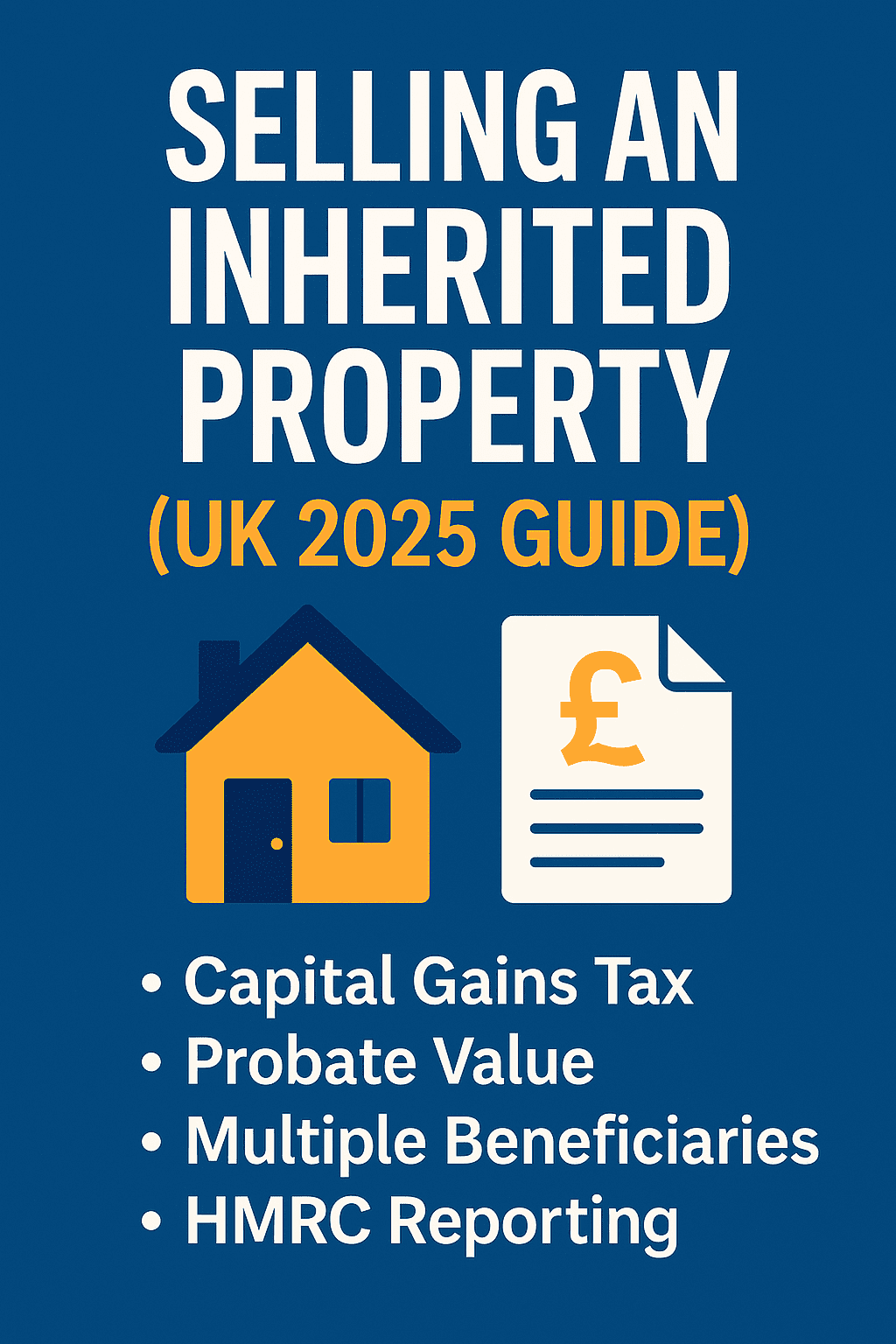
This guide explains the process in simple steps:
- When CGT applies
- How the “Probate value” works
- What happens if siblings inherit together
- Whether Inheritance Tax still applies
- What records the Executor must keep
- Selling a Rental property vs selling a Main home
- Tax rules for overseas beneficiaries
- HMRC reporting requirements (including the 60-day rule)
🎥 If you prefer to watch rather than read, here is the full video guide.
You can now continue with the full written guide below.
Let’s break it down clearly.
1. Do You Pay Capital Gains Tax When You Sell an Inherited Property?
Yes — CGT applies if:
- You inherit a property, and
- You later sell it for more than the Probate value
The key point is:
You do NOT pay CGT on the increase in value before the person died.
Only the increase after the date of death counts.
This is because of the CGT uplift on death.
2. What Is the Probate Value?
Probate value is:
- The property’s open-market value
- On the date the person died
- Usually confirmed by an Estate agent or RICS surveyor
- And used for both Inheritance Tax and CGT
When you sell the inherited property, CGT is based on:
Sale price – Probate value – Allowable selling costs
This is the most important figure in the whole calculation.
3. What if You Inherit the Property With Siblings?
Many families inherit property jointly.
If there are two beneficiaries, each usually inherits 50%.
If there are three, each inherits one-third — unless the Will specifies otherwise.
When the property is sold:
- Each person’s share of the gain is calculated individually
- Each person has their own CGT allowance
- Each may pay a different level of tax depending on income
Executors must keep clear records of:
- Probate value
- Ownership shares
- Selling costs
- Any rental income received during probate
These will be needed for each beneficiary’s Tax Return.
4. What Selling Costs Can Reduce CGT?
You can deduct the following:
- Estate agent fees
- Solicitor fees
- EPC
- Marketing costs
- RICS valuation fees
- Improvement costs (in certain cases)
- Mortgage exit fees (if the estate had a mortgage)
However, refurbishment and upgrade costs during probate must be treated carefully:
- Repairs → allowable
- Improvements → capitalised, but only if they increase value and are part of the Estate’s cost base
Many families get this wrong — and HMRC check CGT calculations carefully.
5. What Happens If the Inherited Property Was Rented Out?
During probate, rental income may continue.
In this case:
- The Estate must report the rental income
- Allowable expenses can be deducted
- Losses can be carried forward within the Estate
- The “CGT uplift” still applies at death
- CGT only applies when the beneficiaries sell their inherited share
If beneficiaries keep the property and rent it out:
- They become Landlords from the date of transfer
- They must declare rental income from that date
- They must keep their own records of income and expenses
- The future gain is calculated from Probate value, not original purchase price
You may find my guide on Rental Losses and Carrying Them Forward helpful if the inherited property has rental income.
6. Do You Need to Pay Inheritance Tax as Well?
You may or may not.
Inheritance Tax (IHT) depends on:
- Estate value
- Whether there was a Spouse
- Whether the home passed to Children
- The Residence nil-rate band
- Unused Spouse allowances
- Gifts made in the last 7 years
- Trusts
Many Estates pay no IHT, even if they involve property.
But the forms may still be required.
You can also read my article on What To Do When Someone Dies, which covers the practical steps before reaching the tax calculation stage.
7. Selling a Home You Lived In (Inherited Main Residence)
If you inherit a property and move into it as your main home, then later sell it, you may get Private Residence Relief (PRR).
This can reduce or eliminate CGT.
However:
- You only get PRR for the period you lived in it
- You do not get PRR for the deceased’s years of ownership
- You do not get PRR for rental periods before or after you lived in it
This must be calculated carefully if the property is sold soon after moving in.
8. Selling a Property Abroad That You Inherited
If you inherit a property overseas and then sell it:
- The UK taxes you on the gain
- The foreign country may also tax the sale
- You can use the Double Taxation Agreement to avoid being taxed twice
- CGT is still based on the foreign probate value
This is a common area of confusion.
If the deceased had foreign income or overseas assets, my article on How Foreign Income Is Taxed In The UK explains the UK reporting rules.
9. How Do You Report the Sale to HMRC? (60-Day Rule)
If the inherited property is residential and in the UK:
- You must report the CGT using HMRC’s 60-day property reporting service
- And pay the CGT within the 60 days
- This is separate from your Self Assessment Tax Return
If HMRC believe the probate value is too low or inconsistent, they may:
- Request evidence
- Ask for valuations
- Compare with Land Registry data
- Open a compliance check
This is why clear records are essential.
10. When You Should Seek Professional Help
You should get advice if:
- You inherited the property with siblings
- The probate value is uncertain
- The property has increased sharply in value
- There were improvements during probate
- The property was rented
- You are selling an overseas property
- There are both IHT and CGT to consider
- HMRC have requested a valuation
Many families prefer a full review before selling so there are no surprises with HMRC later.
Final Word
Selling an inherited property doesn’t have to be confusing.
Once you know how Probate value works, how CGT is calculated, and what HMRC expect, the process becomes much clearer.
If you’d like professional help reviewing your position, you can book a paid diagnostic consultation with us to understand your next steps.