
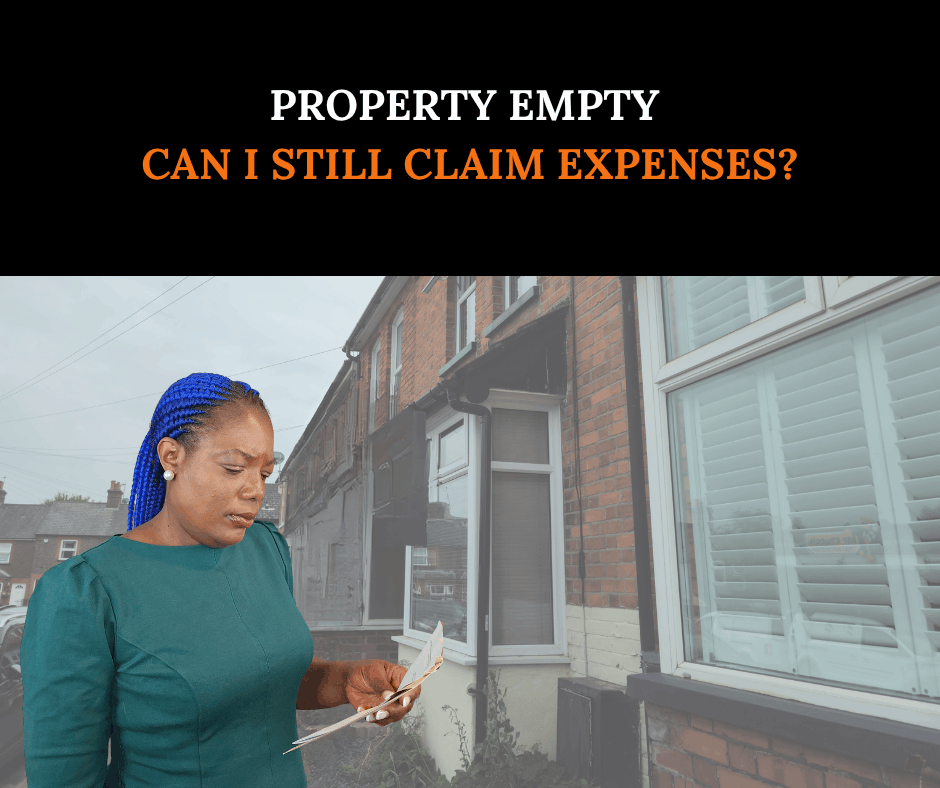

Your tenant has moved out.
The property is empty, and you’re trying to find somebody else to rent it.
But the bills haven’t stopped.
You’re still paying the mortgage. The insurance is due. There may be council tax to pay, and perhaps you’ve had to arrange repairs before the next tenant moves in.
So when you prepare your rental accounts, you might be wondering:
Can I still claim expenses when I’m not receiving any rent?
The answer is potentially yes.
A rental property being empty does not automatically mean that the expenses relating to it are no longer allowable.
But there are some important distinctions.
Does my rental business stop when the tenant moves out?
Not necessarily.
Imagine you’ve been renting out a property for several years.
Your tenant moves out at the end of September. You advertise the property immediately, but you don’t find another tenant until January.
For those three months, the property is empty.
You haven’t received any rent, but your intention throughout has been to continue letting the property.
That is different from deciding to stop renting it out altogether.
HMRC’s guidance on the end of a property business explains that whether a property business has ceased depends on the circumstances.
A temporary gap between tenants will not normally mean that your property business has ended.
And that distinction matters when considering the expenses you continue to incur.
What expenses can I claim while the property is empty?
If the property remains part of an ongoing rental business and is genuinely being held available for commercial letting, ordinary allowable expenses may continue to qualify.
Depending on the circumstances, these could include:
- Landlord insurance: Premiums relating to the rental business, including appropriate cover while the property is unoccupied.
- Council tax: Where you are responsible for paying it during the vacant period.
- Utilities: Gas, electricity or water charges you incur for the property, where they are genuinely for rental-business purposes.
- Repairs and maintenance: Qualifying repairs needed to maintain the property or prepare it for the next tenant.
- Letting agent fees: Allowable costs associated with finding a replacement tenant.
- Service charges and ground rent: Qualifying costs relating to the rental property.
The important point is that these expenses must still satisfy the usual tax rules.
An empty property does not make every expense allowable, just as an occupied property does not make every expense allowable.
The nature and purpose of each cost still matter.
For more on that distinction, read our article Landlord Expenses: Just Because You Paid for It Doesn’t Mean It’s Tax Deductible.
What about the mortgage? I’m still paying it every month
This is where landlords need to be particularly careful.
You may still be paying £900 a month on the mortgage even though no rent is coming in.
But you cannot simply enter the entire £900 as an expense against your rental income.
There is a difference between the mortgage Capital repayment and the Interest element.
For an individual landlord with a residential rental property, qualifying mortgage interest and other residential finance costs are generally subject to the basic-rate tax reduction rules rather than being deducted directly when calculating rental profits.
The capital repayment itself is not an allowable rental expense.
So even if the property is empty, the correct tax treatment of the mortgage still needs to be considered.
Paying the mortgage and claiming a tax deduction are two different things.
What if I spend money repairing the property between tenants?
This is another common situation.
Your tenant leaves, and you discover that the kitchen tap is leaking, some doors need repairing and the walls need repainting.
You arrange for the work to be carried out before advertising the property again.
The fact that nobody is living there when the work takes place does not automatically prevent the expenditure from qualifying.
You still need to consider whether the work is a genuine repair or maintenance expense incurred for the rental business.
For example, replacing a damaged tap with a comparable one may be a repair.
But substantially upgrading the property could involve capital expenditure, which is treated differently.
The distinction is not simply whether the work was done before, during or after a tenancy.
It is also what work was carried out and why.
We explain this further in our article Repairs vs Improvements: What’s the Difference for Landlord Tax?
What if the property stays empty for six months or longer?
There is no simple rule that says expenses become disallowed once a property has been empty for a particular number of months.
The circumstances matter.
For example, imagine two landlords.
Landlord A has an empty property for six months. They continue advertising it, deal with necessary maintenance and genuinely intend to let it again.
Landlord B also has an empty property for six months. But they have decided to keep it for personal use and have stopped looking for tenants.
Both properties are empty.
But the tax position may be very different.
The question is not simply how long the property has been empty.
It is whether the property remains part of a genuine, continuing rental business and whether the expenditure is incurred for that business.
If you have a lengthy vacant period, retain evidence of what you were doing during that time, such as letting advertisements, correspondence with agents and records of necessary maintenance.
What if I have no rental income but still have expenses?
Suppose your property is empty for several months, and you receive little or no rent during the tax year.
You may still have allowable expenditure.
Depending on your overall UK property-business figures, this could result in a rental loss.
Generally, losses from an individual’s UK property business can be carried forward and used against future profits of that same property business, subject to the relevant rules.
However, a rental loss does not normally mean you can simply deduct it from your employment income or claim an immediate tax refund.
Also, if you own more than one UK rental property, the income and expenses will generally be considered together as part of your UK property business.
The correct treatment depends on the overall circumstances and the applicable tax rules.
What if I’ve decided not to rent the property out again?
This is where the position changes.
Suppose your tenant leaves, and you decide to move into the property yourself.
Or you decide that you are finished being a landlord and will no longer offer the property for rent.
You should not assume that expenses incurred after that decision remain ordinary rental-business expenses.
The date the property business ends, the purpose of later expenditure and any applicable post-cessation relief need to be considered.
This is different from a temporary gap between tenants.
And if you had rental income in earlier years, stopping the letting activity does not automatically remove any outstanding tax-reporting obligations.
We’ll explore that question separately in our video, I Stopped Renting Out My Property — Do I Still Need to Tell HMRC?
Video is live tomorrow
What records should I keep while the property is empty?
If your property is vacant, keep a record of what happened during that period.
Useful records may include:
- The date the previous tenancy ended.
- Letting agent correspondence and property advertisements.
- Evidence of attempts to find a new tenant.
- Invoices and receipts for repairs and maintenance.
- Insurance, council tax and utility bills.
- Mortgage interest statements.
- The date a new tenancy began, if applicable.
These records can help establish both the nature of the expenses and whether the property continued to be held for letting.
They may become particularly important if you are preparing tax returns for earlier years or HMRC asks you to explain a period with expenses but no rental income.
The key point
Your rental property being empty does not automatically mean you lose the ability to claim allowable expenses.
A temporary gap between tenants is different from permanently ending the rental business.
The questions to consider are:
- Is the property still genuinely being held for letting?
- Is the rental business continuing?
- What expenses were incurred during the empty period?
- Are those expenses allowable under the usual tax rules?
- What records support the position?
Establishing those facts will help you work out the correct treatment.
Unsure how to deal with expenses during an empty period?
If your rental property has been empty for several months, you’ve continued paying expenses, or you’re preparing tax returns covering periods without tenants, Grace Certified Accountants can help you establish the correct tax position.
We also assist landlords who need to reconstruct earlier rental income and expenses, including where income has not previously been reported to HMRC.
Book a paid Tax & Property Consultation with Grace Certified Accountants to discuss your circumstances.